
BLOG
What are the 9 key performance indicators for RF power amplifiers?
2024-04-03
RF power amplifiers, integral components of various wireless transmitters, play a crucial role in amplifying radio frequency signals. In the preceding stages of a transmitter's circuit, the RF signals generated by modulation oscillator circuits often exhibit minimal power. Therefore, they need to undergo amplification through a series of power amplification stages to attain sufficient RF power before being transmitted through antennas. RF power amplifiers are indispensable in wireless communication systems.
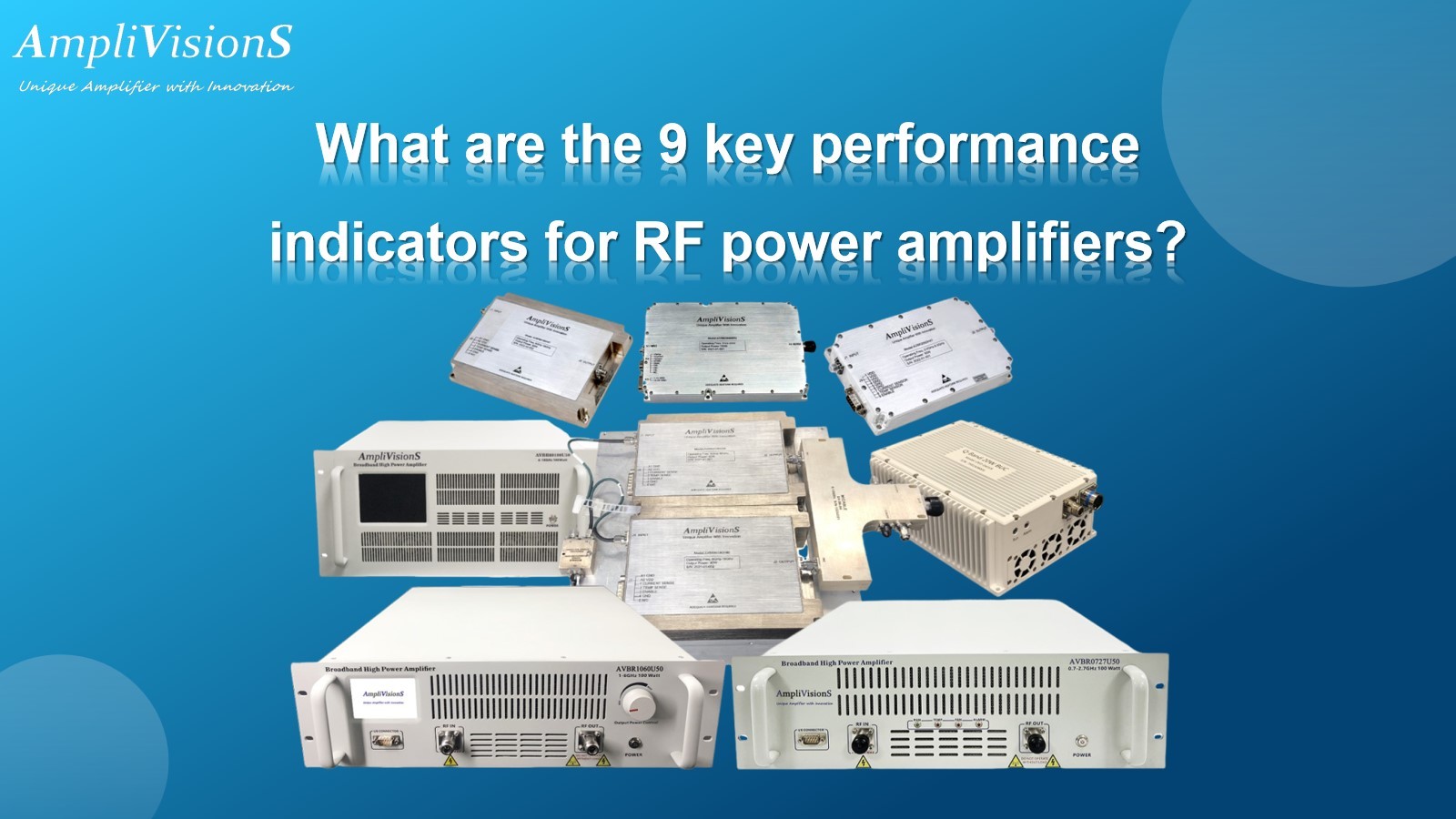
The primary performance metrics of RF power amplifiers include:
1. Output Power and 1dB Compression Point (P1dB): As the input power surpasses a certain threshold, the gain of the transistor begins to decline, resulting in output power saturation. The 1dB compression point indicates the point at which the amplifier's output power deviates by a constant or is lower than the gain of other small signal by 1dB.
2. Gain: Operational gain is the primary metric for measuring the amplification capability of an amplifier. Gain flatness refers to the range within which the amplifier's gain varies across the entire operating frequency band at a certain temperature.
3. Operating Frequency Range: Generally, this refers to the linear operating frequency range of the amplifier, i.e., the frequency range within which the amplifier can operate normally.
4. Efficiency: The efficiency of an amplifier is crucial for the overall efficiency of the system. It is the ratio of the amplifier's high-frequency output power to the direct current power supplied to the transistor.
5. Intermodulation Distortion (IMD): IMD refers to the mixture of components generated by two or more input signals of different frequencies passing through the power amplifier, primarily due to the amplifier's nonlinear characteristics.
6. Third-Order Intercept Point (IP3): When the output power is constant, the higher the output power of the third-order intercept point of the amplifier, the better the linearity of the amplifier.
7. Harmonic Distortion: In high-power amplifier systems, high-order harmonics need to be reduced to a certain level through filters.
8. Dynamic Range: Refers to the difference between the minimum detectable signal and the maximum input power in the linear operating region of the amplifier.
9. Input-Output VSWR (Voltage Standing Wave Ratio): Indicates the degree of match between the RF amplifier and the overall system, which significantly affects gain fluctuations and group delay in the system.
The performance of these metrics directly impacts the performance and stability of RF power amplifiers in wireless communication systems. Therefore, when designing and selecting RF power amplifiers, it is essential to consider a comprehensive range of metrics to meet specific application requirements.

■
RF Power Amplifier Datasheet Guide ——Common Terms & Abbreviations
RF power amplifier datasheets contain a wide range of technical terms and abbreviations. But understanding the numbers starts with understanding what they actually represent.
—
2026-09-18
■
70W Rack-Mount RF Power Amplifier-AVBR2080U48
The AVBR2080U48 is a solid-state broadband RF power amplifier based on Class AB architecture and RF GaN technology. It is specified for operation from 2.0 to 8.0 GHz, with a typical Output P1dB of 43 dBm.
■
SWR vs. Return Loss — How Do You Interpret Them?
VSWR and Return Loss often appear together in RF specifications. What do these two parameters actually tell us, and how should we interpret their values?
■
Under UN Regulation No. 10 (07 series of amendments), the upper frequency limit for automotive radiated immunity testing has been extended from 2 GHz to 6 GHz, reflecting the growing integration of higher-frequency wireless and electronic technologies into modern vehicles.
■
4–8 GHz, Without Switching Amplifiers.
The AVBR4080H47 delivers 50W output power across the full 4–8 GHz frequency range, combining broadband coverage with high RF power in a single amplifier.
■
CW AMPLIFIER VS. PULSE AMPLIFIER
CW and pulse RF power amplifiers may have similar frequency ranges, but their power and thermal considerations can be quite different.