
BLOG
AmpliVisionS Proudly Announces CE and RoHS Certification for COTS RF Power Amplifier Products
2024-07-24
We are thrilled to announce that AmpliVisionS' Commercial COTS RF power amplifier products have successfully obtained both CE certification and RoHS compliance. This achievement underscores our commitment to quality, safety, and environmental responsibility, providing our customers with added assurance when choosing our products.
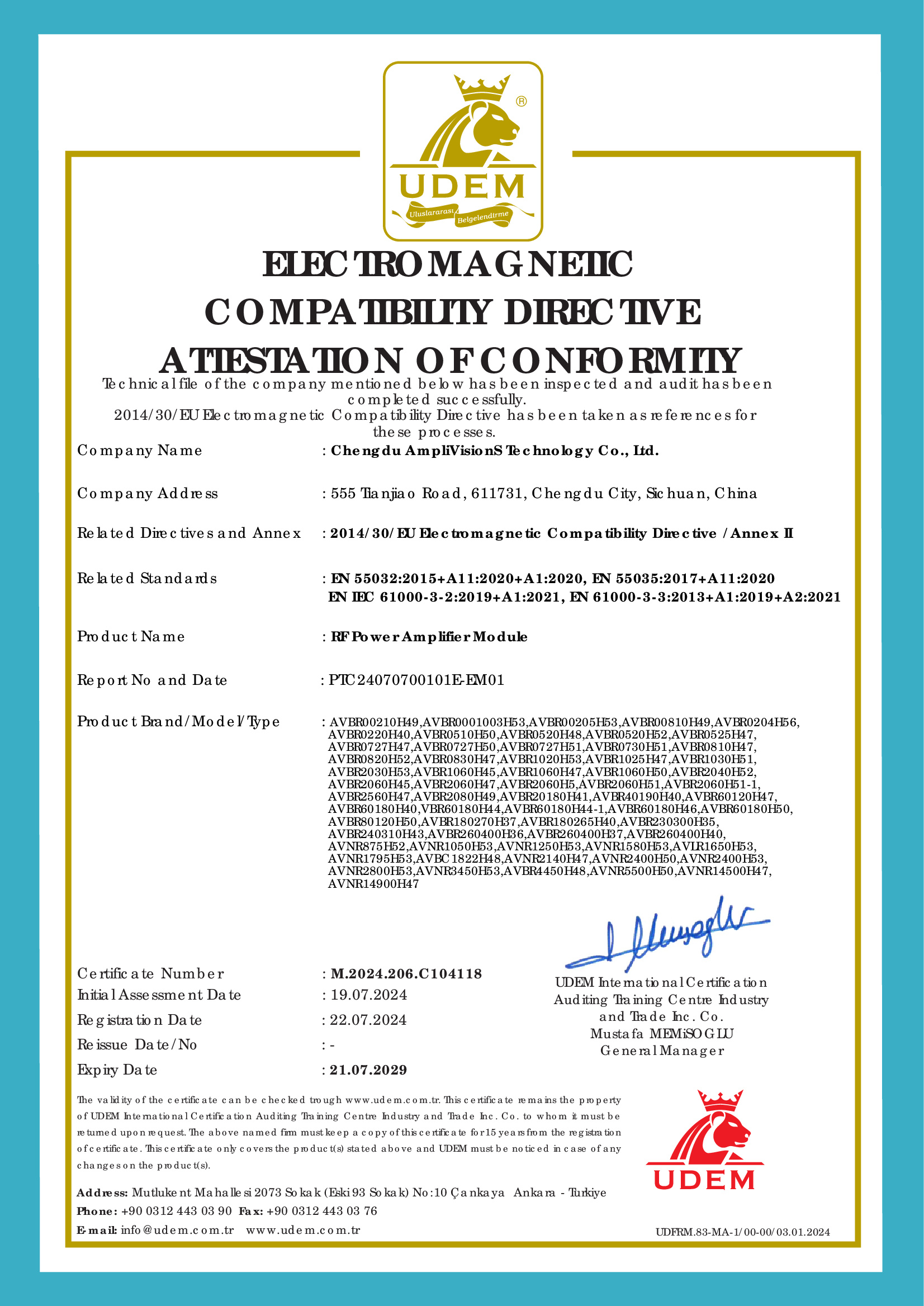
CE Certification: Setting the Standard for Safety and Quality
The CE mark on our COTS RF power amplifiers signifies that these products meet the high standards set by the European Union for safety, health, and environmental protection. This certification allows our products to be freely marketed and sold within the European Economic Area (EEA). It demonstrates that our COTS amplifiers comply with all relevant EU directives, including:
· Electromagnetic Compatibility (EMC) Directive
· Low Voltage Directive (LVD)
· Radio Equipment Directive (RED)
By achieving CE certification, we assure our customers that our COTS RF power amplifiers have undergone rigorous testing and conform to European safety standards, making them suitable for use in various applications across the EU and beyond.
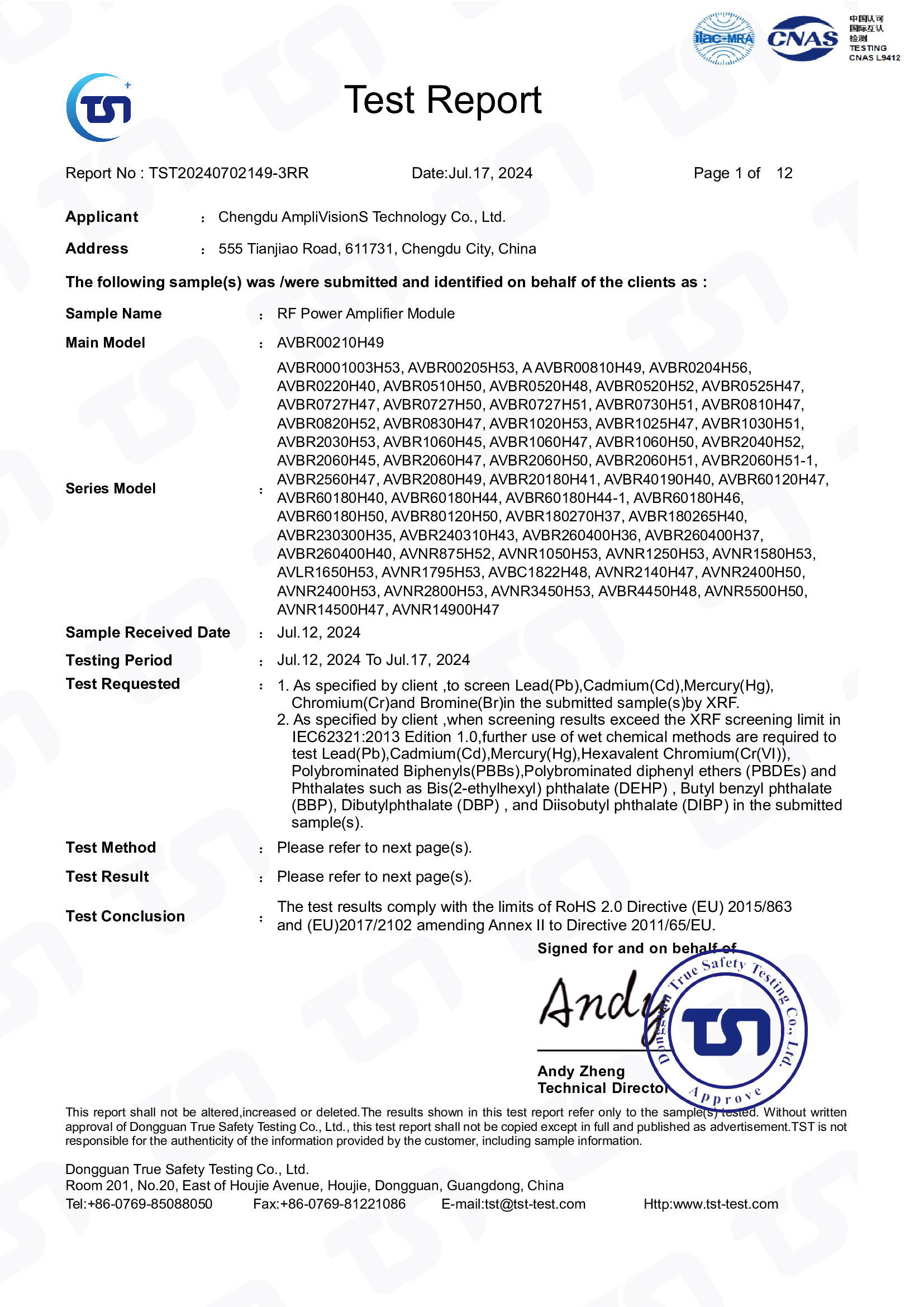
RoHS Compliance: Commitment to Environmental Sustainability
The Restriction of Hazardous Substances (RoHS) directive aims to restrict the use of specific hazardous materials found in electrical and electronic products. Our COTS RF power amplifiers' RoHS compliance certifies that they meet the stringent standards for the following substances:
· Lead (Pb)
· Mercury (Hg)
· Cadmium (Cd)
· Hexavalent chromium (Cr6+)
· Polybrominated biphenyls (PBB)
· Polybrominated diphenyl ethers (PBDE)
This compliance means that any presence of these substances in our products is within the acceptable limits set by the RoHS directive. It demonstrates our dedication to minimizing environmental impact and ensures that our products meet global standards for electronics manufacturing, making them safer for both users and the environment.
Guaranteed Quality: CE certification ensures our COTS products meet stringent European quality and safety standards.
Global Compliance: These certifications facilitate easier market access, not just in Europe but worldwide.
Environmental Responsibility: RoHS compliance reflects our commitment to reducing environmental impact and promoting sustainability.
Peace of Mind: Customers can confidently integrate our certified COTS RF power amplifiers into their systems, knowing they meet international standards.
At AmpliVisionS, we continuously strive to improve our products and processes to meet and exceed global standards. These certifications for our COTS RF power amplifiers are a testament to our ongoing commitment to excellence and customer satisfaction.

■
400W High Power Pulsed Amplifier——AVPR1100H56
The AVPR1100H56 is an L-band solid-state pulsed power amplifier based on high-power RF LDMOS technology, with integrated control, monitoring, and protection functions.
—
2026-10-09
■
Our team will be on holiday from October 1 to October 7, 2026, and normal business operations will resume on October 8, 2026. During the holiday, our response time may be slightly longer than usual. We appreciate your understanding and patience.
■
ONE MOON, A THOUSAND YEARS OF MEANING
Happy Mid-Autumn Festival.
■
RF Power Amplifier Datasheet Guide ——Common Terms & Abbreviations
RF power amplifier datasheets contain a wide range of technical terms and abbreviations. But understanding the numbers starts with understanding what they actually represent.
■
70W Rack-Mount RF Power Amplifier-AVBR2080U48
The AVBR2080U48 is a solid-state broadband RF power amplifier based on Class AB architecture and RF GaN technology. It is specified for operation from 2.0 to 8.0 GHz, with a typical Output P1dB of 43 dBm.
■
SWR vs. Return Loss — How Do You Interpret Them?
VSWR and Return Loss often appear together in RF specifications. What do these two parameters actually tell us, and how should we interpret their values?